Tech-BLOG

Emerging cyber threats you should be concerned about?


iStock 000028716526 MediumIn this digital world, we are obsessed with the technology. Technology is changing every second. With the emergence of technology, the threats in the cybersecurity are increasing every day.

Cybersecurity comprises technologies, processes, and controls that are designed to protect systems, networks, and data from cyber-attacks. Effective cybersecurity reduces the risk of cyber-attacks and protects organizations and individuals from the unauthorized exploitation of systems, networks, and technologies.

Consequences of a Cyber-attack

Cyber-attacks can disrupt and cause considerable financial and reputational damage to even the most resilient organization. If you suffer a cyber-attack, you stand to lose assets, reputation, and business, and potentially face regulatory fines and litigation – as well as the costs of remediation.

Currently, we are facing a lot of cyber-attacks in terms of monetary fraud and information breaches.

Now a day’s common people have no idea about the potential threats. They often get exposed to social engineering. They often give their information to any third party who is having malicious intent. As a result, they suffer the loss in terms of money, data or information.

In India, most of the information of an individual is linked with aadhar card. It provides a unique identification number to the individual. It has the thumbprint and fingerprints of a person. The bank account is also linked with aadhar card. So it is our responsibility to secure that information from the hackers.


To know more about hacking read 


rcjCyberThreat2Threats to organization

All Internet-facing organizations are at risk of attack. And it’s not a question of if you’ll be attacked, but when you’ll be attacked. The majority of cyber-attacks are automated and indiscriminate, exploiting known vulnerabilities rather than targeting specific organizations. Your organization could be being breached right now and you might not even be aware.

Up to 70% of emails today are spam, and the vast majority of these still involve phishing scams. Other common hacking threats include ransomware, malware, and Distributed denial-of-service (DDoS) attacks, all of which have been responsible for major data breaches in recent months and which can leave both company and customer data vulnerable to cyber-criminals. A massive 93% of data breaches are motivated by financial gain, according to a recent Verizon report. Hackers aim for the highest return for the least amount of effort, which is why smaller businesses with lax security are often successfully targeted.

virusscannerBanking, Financial Services and Insurance (BFSI): The BFSI sector is under growing pressure to update its legacy systems to compete with new digital-savvy competitors. The value of the customer data they hold has grown as consumers demand a more convenient and personalized service, but trust is essential. Some 50% of customers would consider switching banks if theirs suffered a cyber-attack, while 47% would “lose complete trust” in them, according to a recent study. A number of major banks around the world have already been subject to high-profile cyber-attacks suggesting that the sector needs to improve its approach to risk. Financial firms should invest in security applications that are able to adapt to the future of banking to ensure comprehensive, around-the-clock security. Shared Ledgers will feature prominently in the future of the BFSI sector, the best-known example of which is Blockchain, which forms the backbone of cryptocurrency Bitcoin. The blockchain is a database that provides a permanent record of transactions. It leaves an undisputed audit trail that can’t be tampered with, meaning it could completely transform security in the BFSI sector.

AI integrated attacks

AI is a double-edged sword as 91% of security professionals are concerned that hackers will use AI to launch even more sophisticated cyber-attacks.


AI can be used to automate the collection of certain information — perhaps relating to a specific organization — which may be sourced from support forums, code repositories, social media platforms and more. Additionally, AI may be able to assist hackers when it comes to cracking passwords by narrowing down the number of probable passwords based on geography, demographics and other such factors.

Telecom: There is a significant cybersecurity risk for telecom firms as carriers of internet data, and therefore a huge responsibility. Providers need to integrate cybersecurity measures into network hardware, software, applications and end-user devices in order to minimize the risk of a serious data breach, which could leave customer credentials and communications vulnerable. Consumers are increasingly careful about who they entrust their personal data to, providing a strong opportunity for networks that offer additional security services. In addition, a collaboration between rival operators could lead to greater resilience against cyber attackers.

screen shot 2015 10 27 at 9.39.25 pm


As technologies progress, the skills needed to deal with cyber-security needs are changing. The challenge is to train cyber-security professionals so that they can deal with threats as quickly as possible and also adapt their skills as needed. There will be some 3.5 million unfilled cyber-security roles by 2021.

Designing a logo—Creativity in graphics


The creative design comes in handy while working in the field of graphic design. After all, it’s too easy to lose steam in the midst of cranking out design after design. Fear not! For your inspiration needs, we’ve combed through every inch of the internet to bring you the best design existence.

imagesResearch your audience: Designing a logo is not just about creating an appealing visual. Like the overall color scheme and design of your site, your logo sets your brand apart from the competition and shows people that you’re a legitimate business. Logos are a critical part of the modern visual landscape. Throw yourself into the brand. Save all your sketches. Research online. Create mind maps or mood boards. Build a board and tear it apart. Stop with the clichés. Know your customer need. Give him/her a variety of different design to think on. Ask your customer about the message he/she want to convey via the logo. Don’t just be a designer – be a good one. Designing an effective logo is not a quick or easy process. What it requires is through research, thought, care and attention to ensure the final logo design targets the correct market and broadcasts the right message. A poorly designed logo will have a negative effect on the perception of your business; however, a carefully designed logo can transform a business by attracting the right people.

Idea generation: When working on designs you should start on paper, using numerous idea generation techniques, such as brainstorming and word mapping. This is typically a very organic process and can vary from project to project. Any idea that comes to mind will be sketched on paper to explore the full depth of potential ideas for the logo design. You should be updated with the current trend in the graphic designing. It’s wild to see dozens of design examples categorized by their inherent design trend. Each page even has a small infographic for each trend displaying popularity by year. Quite revealing!

images 1Once the idea has been explored on paper you should begin to work on the designs using software called Adobe Illustrator, which is a vector-based software program, which means the artwork produced is scalable and will never lose quality. You should continue to explore and experiment with the ideas even during this state, to ensure the idea produced is presented in its best possible light. Use vector shapes in Adobe Illustrator CC to create a logo that looks good onscreen and in print. The best part about vector art is that it scales to any size. It can be a small business card or a large billboards vector art can be resized and it will not lose its quality. Try to know about the golden circle ratio. It will help you to get a better understanding of various designs.


Once you have made several solid designs prepared, you will have an incubation period of at least a day, where you will not look at the designs. During this time you may consider new ideas which you would like to explore and can return to the project with a fresh perspective. Following this period you should return to the designs, refine the work where needed and select the most suitable designs to present. Add vector design in your logo and create some mind-blowing designs in order to draw your clients

magento logo11Designing the Idea and presenting:  Once designs are ready to present you should create a PDF document which will display the logo designs created, with images of the designs in real life examples, along with supporting notes explaining the decisions made. We only present designs which we are confident in, and will give you my opinion on which you believe will be most suitable for your client’s business. You should leave the final choice to your client, and if there is any possibility of improvement in design, the design could be improved or modified to better meet the objectives, changes can be made where necessary.

Finalizing the Project:   Once the designing process is completed; and we are both satisfied with the final design work, we will be finalizing the new logo files for use on web and print. You are also supposed to prepare a logo usage document to help you make the most of your new logo as your business grows, and if at any point you need help with your logo files you should be available to help and support your client ongoing.


The Reality of Dreams


“Have you ever imagined standing in front of a dinosaur or walking on a different planet full of alien life?”


Probably. But is it really possible? The answer is yes and no. We certainly can’t bring back the dinosaurs. But we can make you walk on mars while still being in your hallway. How is that possible? Though Virtual Reality.


Virtual reality isn’t a new thought. As long as humans have lived they have dreamed and some have tried to make them real too. But creating a reality isn’t an easy thing. There have been other mediums through which people have portrayed their imagination. Just look at the various artists of fine arts. But nothing really equals something that can actually react to our stimuli.


The realms of possibilities:

Virtual Reality doesn’t happen just happen on a screen in front of you, but it happens all around you creating a feeling of being in an alternate reality altogether. This has quite a profound impact on anybody who witnesses it. And because of this factor, we have found some extraordinary uses for it. Let’s look at some of these:

  • vr2Training: The most revolutionary use of Virtual Reality has been in the training especially in those fields that involve high-risk operations like in the military, medical. Pilots and medical professionals like surgeons carry out some of the riskiest and dangerous operations in their field of work e.g. flying a military aircraft/ a brain surgery. In these situations, any untrained or undertrained person cannot be employed. Enter Virtual Reality, with modern day simulation systems a person can be trained for both situations without taking any risk on failure. Thereby providing these professionals the absolute necessary experience in handling the situation perfectly.


  • Mental Health: Virtual Reality has been useful in treating some mental health issues such as post-traumatic stress. By making the patient go through the similar experience again the medical professionals help them cope with the situation they fear and avoid. It has also been particularly helpful for people suffering from autisms. By using Virtual Reality, they are learning to interact in the society thereby overcoming their barriers. To them, Virtual Reality is nothing less than a blessing.


  • vr3Entertainment: Virtual Reality has been booming in the sector and it is believed that Virtual Reality will find the most useful in this sector from games to movies everything is being researched and developed to provide the most realistic experience to the viewer. 3D is now a thing of the past as the world is trying for 5D, a viewing experience where you can physically feel the experience like walking with the characters.


vr9

  • Augmented Reality: I’m sure everyone who has ever watched the Marvel’s Ironman movies must have wished to have their personal Jarvis. Well, that is what we call augmented reality. It is an effort to create a reality which is a combination of both the Virtual and Real space around you. Using Virtual Reality, we create a virtual layer over the real space and through the interaction with the virtual space we can carry out tasks. Of course, some physical work has to be done by you. We are just not there yet. Microsoft made an effort in this area with the HoloLens. And if not for anything it did work as a technology demonstrator for the future possibilities in that area.


  • Business: Business has always employed the latest technology to become more efficient in their process of conducting all activities. Virtual Reality has significant potential to reduce the human effort in conducting some operations like business travels, conducting intervr5views, giving tours, forecasts trends and meetings. Solutions like virtual conference rooms can create a significant impact on the ways of conducting business.


  • Design: Designers always need access to newer to help them better visualize their design. Just as CAD (Computer Aided Design) once revolutionized the design industry. The new Virtual Reality is the latest revolution, the best, that a designer can hope for. With the 3D rendering of their designs in a 3D space will enormously aid in the creativity and pace of design.


The unlikely pioneer- Games

When it comes to dreams and an alternate reality nothing can match the business of selling dreams and that is the gaming industry. In modern times, the best new technologies in the field of realism have come in the gaming industry and the gaming companies have gone above and beyond to create more realistic looking games. The leading gaming giants like Sony, Microsoft and Nintendo are all racing each other to capture the newly created market with the potential of billions. Each of them releasing latest and better VR console as soon as possible. And a healthy competition may certainly benefit the general populace as the best and latest become available at the cheapest price.


Conclusion:

The pace at which the technology is growing nowadays. The reality of dreams, where no one must carry a cell phone.
Where everyone will have a personal virtual assistant like Jarvis from Ironman that even talks to you isn’t far away.

Virtual Reality will bring the new revolution in the technology of future. Let me be bold and say this, VR is the future. And it is here.

Self-Driving Cars – The Driverless Experience

Self-driving cars, also known as autonomous vehicles, represent one of the most revolutionary advancements in modern transportation. These vehicles are designed to navigate and operate without direct human input, using a combination of sensors, cameras, radar, and artificial intelligence (AI). The goal of self-driving technology is to make travel safer, more efficient, and more accessible.

Autonomous cars rely on advanced software that processes real-time data from their surroundings to make driving decisions such as steering, braking, and acceleration. They can identify road signs, pedestrians, other vehicles, and obstacles, ensuring smooth and safe navigation even in complex environments.

Companies like Tesla, Google (Waymo), and Uber have made significant progress in developing and testing these vehicles, aiming for a future where accidents caused by human error are drastically reduced.

Beyond safety, self-driving cars could change how we view commuting and vehicle ownership. They can potentially reduce traffic congestion, improve fuel efficiency, and offer mobility solutions for the elderly and disabled.

While challenges remain—such as legal regulations, ethical decision-making in emergencies, and cybersecurity risks—the progress so far suggests that autonomous driving is no longer just science fiction. It’s a glimpse into the future of smart, AI-powered transportation.

Introduction to Hacking

hh1

Hacking is an attempt to exploit a computer system or a private network. It is said to be unauthorized access to someone’s computer. It is a security breach to a network or a system and extraction of some data or information without permission. Computer hacking refers to the practice of modifying or altering computer software and hardware to accomplish a goal that is considered to be outside of the creator’s original objective.

The person engaged in hacking activities is known as a hacker. This hacker may alter system or security features to accomplish a goal that differs from the original purpose of the system. The majority of hackers possess an advanced Knowledge of computer technology. The typical computer hacker will possess an expert level in a particular computer program and will have advanced abilities in regards to computer programming.

Now I am going to list down the types of hackers:

1. Script Kiddie: You can say that they are the noobs of the digital world. they don’t know real hacking nor do they care. They just copy the codes and use it for virus or SQL injection. A common Script Kiddie attack is DoSing or DDoSing (Denial of Service and Distributed Denial of Service), in which they flood an IP with so much information it collapses under the strain.

2. White Hat\ Ethical Hackers: These are the good guys of the hacker world. They often provide cybersecurity to different companies. They can help you to remove viruses. White Hat hackers hold a college degree in IT security or computer science and must be certified to pursue a career in hacking.

3. Black Hat /Crackers: They are the notorious pirates who people are scared of. They find banks or other companies with weak security and steal money or credit card information. The surprising truth about their methods of attack is that they often use common hacking practices they learned early on. They can destroy any system and extract the valuable information.

4. Gray Hat – Nothing is ever just black or white; the same is true in the world of hacking. Gray Hat hackers don’t steal money or information (although, sometimes they deface a website or two), yet they don’t help people for good (but, they could if they wanted to).

5. Green Hat– They care about hacking and strive to become full-blown hackers. They’re often flamed by the hacker community for asking many basic questions. When their questions are answered, they’ll listen with the intent and curiosity of a child listening to family stories. They are money minded hackers and they only hack for money.

6. Blue Hat – When a Script Kiddie took revenge, he/she might become a Blue Hat. Blue Hat hackers will seek vengeance on those who have made them angry. Most Blue Hats are noobs, but like the Script Kiddies, they have no desire to learn.

7. Red Hat: These are the vigilantes of this digital world. They don’t care to arrest or report black hats rather they would like to shut them for good. They use multiple aggressive methods that might force a Blackhat to need a new computer. They focus to destroy blackhat from the root.

A Revolution In The Billing Of Hospital


A Revolution in Hospital Billing

It gives us immense pleasure to announce that Jain Software has created a true revolution in the billing segment of medical science. We are proud to introduce our Medical Management Software, designed specifically for doctors, dentists, surgeons, and medical shop owners. This powerful, feature-rich product simplifies daily operations and significantly enhances efficiency. With the flexibility of anytime, anywhere, any-device access, it works seamlessly on smartphones, tablets, and computers.


Key Features of HosBill

1. Smart Appointment Scheduling

Gone are the days of long queues of waiting patients. HosBill intelligently schedules appointments based on the number of patients a doctor can handle per hour. In case of emergencies, appointments can be easily rescheduled. Patients can also book normal or emergency appointments online through a secure portal. To ensure confirmation, the system even allows patients to pay a small token amount digitally.


2. Accurate Patient Information Management

Say goodbye to misplaced prescriptions and lost reports. HosBill stores every single patient detail, including medical history, prescriptions, and reports, all with accurate timestamps. Doctors can easily retrieve records whenever needed — no more hunting through piles of paper.


3. Comprehensive Case Tracking

Imagine a patient returning after ten years and asking for details of a past treatment. Searching old files would be impossible — but not with HosBill. The software maintains a patient’s medical history for up to 120 years, ensuring no data is ever lost. Every record is safely stored and can be accessed within seconds.


4. Diagnostic Lab Integration

Whether it’s an LFT test, sugar level check, or an X-ray report, HosBill keeps every diagnosis neatly organized. It automatically stores lab results and updates them in the patient’s profile. This next-generation hospital management software ensures all medical data stays at your fingertips without extra cost.


5. Multi-Location Access

HosBill allows access from multiple locations, users, and roles simultaneously. Whether you’re managing a single clinic or multiple branches, data synchronization happens in real-time. This makes HosBill a perfect choice for hospitals and healthcare networks of all sizes.


6. Intelligent Medicine Suggestions

Having trouble remembering which medicines were prescribed for specific symptoms? HosBill takes care of that. The system automatically suggests medicines based on recorded symptoms and adds them to the patient’s billing and prescription. You can even define custom medicines for specific symptoms, combining automation with your medical expertise.


7. Access to Previous Patient Records

HosBill enables doctors and staff to track pending bills and outstanding dues instantly — without manually checking each patient’s billing history. The system sends automatic notifications, keeping you informed at all times.


8. Streamlined Billing and Invoicing

Create professional invoices that carry your hospital’s name and logo — completely free from software watermarks. HosBill works both online and offline, and supports multiple currencies, including Indian Rupees and US Dollars. This makes it ideal for hospitals that serve international patients as well.


9. Fully Responsive Design

Want to access patient data or billing information on the go? HosBill is fully optimized for mobile devices, allowing doctors and staff to check real-time updates anytime, anywhere. It’s smooth, fast, and reliable — designed with modern healthcare professionals in mind.


10. 100% Uptime Guarantee

We understand that downtime can be costly for hospitals. That’s why we host HosBill on MNCHost, a part of the Jain Software Foundation, trusted by leading multinational corporations. We guarantee high-speed performance, complete data security, and 100% uptime — all at a minimal hosting cost.


Conclusion

With HosBill, Jain Software is redefining how hospitals handle billing, patient management, and operational efficiency. It’s not just a software — it’s a step toward smarter healthcare.

We continuously strive to innovate and improve based on your feedback.
If you have any suggestions or queries, please reach out to us — your feedback is valuable to us.

📞 Call us: +91-771-4700-300
📧 Email: Global@Jain.software
🌐 Website: www.jain.software

How important cyber security is?


Cybersecurity – Protecting the Digital World

Cybersecurity is the body of technologies, processes, and practices designed to protect networks, computers, programs, and data from attack, damage, or unauthorized access. In the computing world, security includes both cyber security and physical security. Cybersecurity specifically focuses on protecting data found in electronic form. It involves identifying what data is most critical, where it resides, and what technologies are necessary to keep it safe.

Over the past decade, there has been a growing fusion between cybersecurity and information security. As these two areas continue to overlap, the responsibilities of cybersecurity professionals have expanded significantly. Many organizations do not have dedicated information security professionals, so cybersecurity teams are now required to manage both technical defenses—like firewalls and intrusion detection systems—and broader data protection strategies.

We are living in an era where businesses are more digitally advanced than ever before. As technology continues to evolve, companies must enhance their security systems to stay protected. Failing to do so can lead to costly data breaches, as has been the case for many large organizations in recent years. Cyber attackers are targeting all types of businesses, regardless of their size or industry.

To safeguard your company’s data, finances, and reputation, it is essential to invest in a strong cybersecurity framework. Before building a security program, however, it is important to understand the different types of security and how they work together.

Cybersecurity, a key component of information security, focuses on defending your organization’s networks, systems, and data from unauthorized digital access, attacks, or damage. This involves using advanced technologies, implementing strong security policies, and regularly monitoring your systems for potential threats.

In today’s interconnected world, cyber threats are growing more sophisticated every day. From phishing scams and ransomware attacks to data breaches and identity theft, the risks are ever-present. Therefore, securing your IT infrastructure is no longer optional—it’s a necessity. Continuous monitoring, timely updates, employee awareness, and proactive defense mechanisms are essential to prevent full-scale cyberattacks and protect your company’s valuable data and reputation.

Jain software has developed a powerful tool General Billing Management System (Gen Bill) with highly advanced mechanism.

GenBill – The Revolution in Billing Systems

With improved efficiency and cutting-edge innovation, GenBill has created a massive revolution in modern billing systems. Delivering unparalleled performance compared to Tally ERP 9, GenBill operates up to 9 times faster, setting a new benchmark in speed and reliability. It’s not just software—it’s an innovation built for success. Designed for simplicity, even users with minimal accounting knowledge can operate it easily.


Key Features of GenBill

1. Dual Mode: Online & Offline

Need to generate a bill but don’t have an internet connection? No problem! GenBill runs seamlessly in both online and offline modes, depending on your business requirements.

  • Offline Mode: Ideal for businesses with a single system or limited connectivity.

  • Online Mode: Access your billing data anytime, anywhere—from your mobile, laptop, or other systems—in real time.


2. Multi-User Access

Running multiple branches? GenBill allows access from 100+ systems globally. Whether your team is local or remote, everyone can stay connected and manage billing operations effortlessly.
Stop worrying—start billing smarter with GenBill!


3. Fully Personalized Experience

No matter the size of your business, GenBill can be personalized to reflect your brand identity—your company name, logo, and theme—all at no extra cost.
Even your invoices carry your brand logo, giving your business a professional touch. Customize your software whenever you want, however you want—complete flexibility at your fingertips.


4. Invoice on Emails

Go green and save time! GenBill automatically emails invoices to your customers the moment a sale is created. Say goodbye to unnecessary printing—your customers receive a professional, automated invoice instantly in their inbox.


5. Fully Responsive Design

Whether you’re on a mobile, tablet, laptop, or MacBook, GenBill adapts perfectly to every device—no need for separate applications. This flexibility is powered by our highly skilled team of logical thinkers who ensure a flawless user experience across all platforms.


6. Minimal Cost – Maximum Value

GenBill is affordable, efficient, and fully customizable to meet your business needs—without hidden or extra charges. Many businesses already trust GenBill for their daily billing, accounting, and staff management, proving its reliability and cost-effectiveness.
We value your money and your trust.


7. Advanced Security

Your business data is precious, and GenBill ensures it stays protected. With multi-level access controls, you can restrict employees to specific sections of the software and secure others with master passwords. This level-wise security system ensures your confidential data remains safe at all times.


Experience the Future of Billing

GenBill isn’t just software—it’s your complete business billing solution. With its speed, personalization, accessibility, and strong security, it transforms the way your business manages billing operations.

Switch to GenBill today and experience efficiency like never before!

A Complete Solution To Manage Inventory

IN-MAN: The Ultimate Innovation in Inventory Management by Jain Software

In the pursuit of technological excellence, Jain Software proudly introduces IN-MAN, an advanced Inventory Management System designed to redefine efficiency and precision in managing inventory, orders, and sales.

Built with intelligence and reliability, IN-MAN operates seamlessly in both online and offline modes, ensuring uninterrupted access and control even without internet connectivity. Its latest version features a sleek, user-friendly interface developed after in-depth analysis of business operations across multiple industries.


Key Features of IN-MAN

1. Access Levels

No matter which department you belong to — order management, accounting, or delivery — IN-MAN ensures secure and role-based access for every team.
Each department works within its own module, eliminating unauthorized access between teams. Administrators have full access to all modules and can assign multiple roles as needed. The system is completely customizable to align with each client’s operational structure.


2. Multi-User and Multi-Unit Functionality

Multiple users can operate the software from different locations simultaneously.
For example, while an administrator reviews reports, the order management team can place new orders — and IN-MAN automatically updates the data in real time. This feature promotes accuracy, transparency, and teamwork across departments.


3. Critical Stock Notifications

Say goodbye to manual stock monitoring.
IN-MAN automatically sends notifications to users and administrators whenever any product’s stock reaches the minimum threshold. This ensures timely restocking, prevents shortages, and maintains smooth workflow continuity.


4. Dual-Mode Operation (Offline + Online)

Whether you operate from a single office or manage multiple branches, IN-MAN adapts effortlessly to your setup.

  • Offline Mode: Perfect for locations without internet connectivity — continue operations without interruptions.

  • Online Mode: Manage multiple branches or warehouses through a cloud-based system with real-time synchronization.

Both modes are available at no additional cost, offering flexibility and convenience.


5. Advanced Crystal Reports

Powered by Jain Software’s 4th generation reporting system, Crystal Reports revolutionize how businesses view and understand their data.
It transforms complex datasets into intuitive visual insights, empowering organizations to make informed, data-driven decisions with ease.


6. Sales and Stock Tracking

IN-MAN doubles as a billing and invoicing solution.
Users can generate invoices, record orders, and automatically update stock levels. The system ensures auto-stock deduction after each sale, maintaining precise inventory control and reducing manual work.


7. Full Automation

Automation is the backbone of IN-MAN. The system takes care of routine processes, including:

  • Automatic stock deductions after each sale

  • Real-time progress updates

  • Instant email notifications for new orders or stock updates

This smart automation is why more than 23 businesses across Raipur and Hyderabad trust IN-MAN to streamline their operations and boost productivity.


8. Multi-Currency Invoicing

For businesses dealing with international clients, IN-MAN offers multi-currency invoicing with precise conversion rates.
Whether your clients transact in dollars, euros, or rupees, IN-MAN ensures smooth, accurate, and compliant financial operations.


9. Fully Responsive Design

Access your business anytime, anywhere.
IN-MAN is fully responsive, allowing you to monitor inventory, track sales, and view reports from any device — desktop, tablet, or smartphone. This mobility is made possible by Jain Software’s innovative development team in Raipur.


10. 100% Uptime Guarantee

Your software deserves reliability.
IN-MAN is hosted on MNCHOST, a division of Jain Software Foundation, which powers hosting for multinational corporations worldwide.
With MNCHOST, clients enjoy uninterrupted uptime, robust performance, and cost-effective hosting solutions, ensuring your business runs seamlessly around the clock.


The Ultimate Solution for Inventory Management

With its advanced technology, flexibility, and automation, IN-MAN is not just software — it’s a complete inventory management ecosystem for modern businesses.

At Jain Software, innovation never stops. We continually refine our products based on your feedback to deliver smarter, faster, and more reliable solutions.

What would you like to see next in IN-MAN?
Your ideas drive our innovation — because your success is our mission.

Paper Battery

Let us first know what is a Paper battery?

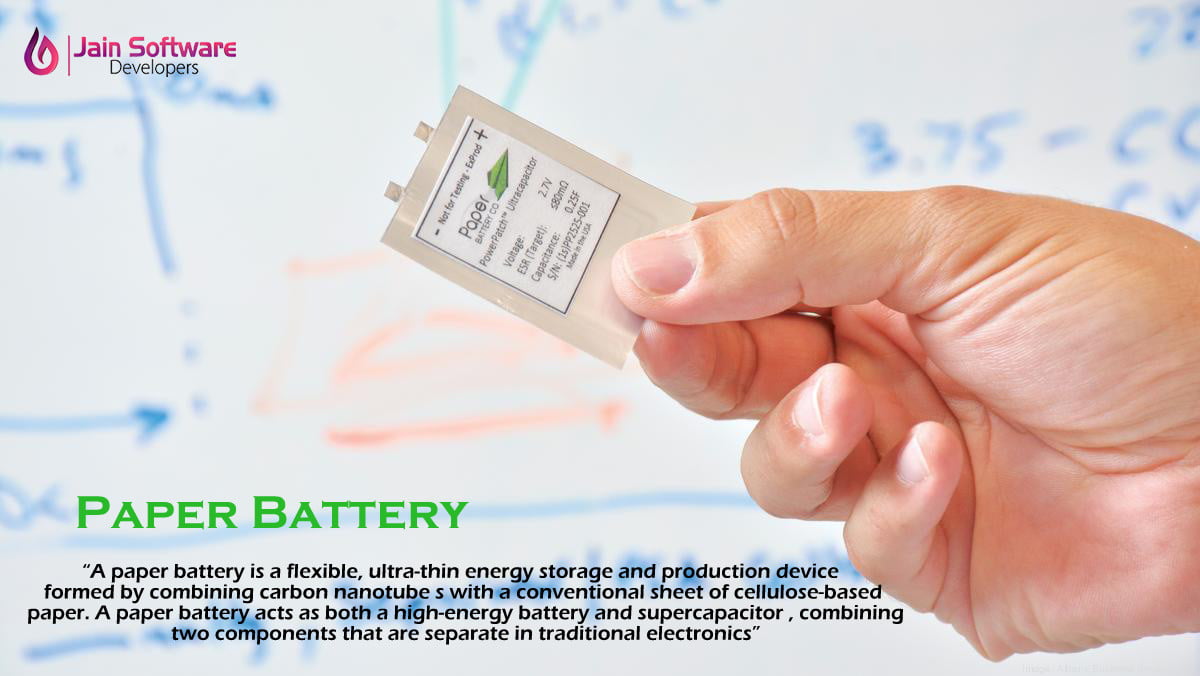
A paper battery is a flexible, ultra-thin energy storage and production device formed by combining carbon nanotube s with a conventional sheet of cellulose-based paper. A paper battery acts as both a high-energy battery and supercapacitor, combining two components that are separate in traditional electronics. This combination allows the battery to provide both long-term, steady power production and bursts of energy.In addition to being unusually thin, paper batteries are flexible and environmentally-friendly, allowing integration into a wide range of products. Their functioning is similar to conventional chemical batteries with the important difference that they are non-corrosive and do not require extensive housing.

How does Paper Battery work?

The conventional rechargeable batteries which we use in our day-to-day life consist of various separating components which are used for producing electrons with the chemical reaction of a metal and electrolyte. If once the paper of the battery is dipped in ion-based liquid, then the battery starts working i.e.,electricity is generated?by the movement of electrons from cathode terminal to anode terminal. This is due to the chemical reaction between the electrodes of paper battery and liquid. Due to the quick flow of the ions within a few seconds (10sec) energy will be stored in the paper-electrode during the recharging. By stacking various paper-batteries up on each other, the output of the paper battery can be increased.As the paper batteries are connected each other very closely for increasing their output, there is a chance of occurring short between the?anode terminal and cathode terminal. If once the anode terminal contacts with cathode terminal, then there will be no flow of current in the external circuit. Thus, to avoid the short circuit between anode and cathode a barrier or separator is needed, which can be fulfilled by the paper separator.


“Technology is driving the innovation. Technology is driving the creativity”


What are Paper Battery Properties?

The properties of the paper battery can be recognized from the properties of cellulose such as :-

  • excellent porosity
  • biodegradability
  • non-toxic
  • recyclability
  • high-tensile strength
  • good absorption capacity
  • low-shear strength

also from the properties of carbon nanotubes such as low mass density, flexibility, high packing density, lightness, better electrical conductivity than silicon, thin (around 0.5 to 0.7mm), and low resistance.

Paper Battery Manufacturing:-

One method is to grow the nanotubes on a silicon substrate and then filling the gaps in the matrix with cellulose. When the matrix is dried, the material can be removed the substrate. Combining the sheets together with the cellulose sides facing inwards, the battery structure is formed. The electrolyte is added to the structure.


“Technology will not replace great teachers but technology in the hands of great teachers can be transformational”


Applications of Paper Batteries:

With the developing technologies and reduction in the cost of cathode nanotubes, these batteries find applications in the following fields:

  • Nanotubes used for Paper Battery

Paper Battery= Paper (Cellulose) + Carbon Nanotubes

The paper battery can be used for various applications as it facilitates advantages such as folding, twisting, molding, crumpling, shaping, and cutting without affecting on its efficiency. As the paper batteries are the combination of cellulose paper and carbon nanotubes, which facilitates advantages of long-term usage, steady power, and bursts of energy. These types of paper batteries are estimated to use for powering the next generation vehicles and medical devices.

  • Paper batteries in electronics

Paper batteries are used mainly in many electronic devices, such as mobile phones, laptop batteries, calculators, digital cameras and also in wireless communication devices like mouse, Bluetooth, keyboard, speakers, and headsets.

  • Paper batteries in medical sciences

Paper batteries are used in the medical field such as for making pacemakers for the heart, artificial tissues, drug delivery systems, cosmetics and in Biosensors.

  • Paper batteries in automobiles and aircraft

Paper batteries are used in automobiles and aircraft such as in lightweight, guided missiles, hybrid car batteries, long air flights and in satellite programs for powering electronic devices.

This is all about the paper battery with its working principles and applications.

These batteries have the potential adaptability to power the next generation electronic appliances, medical devices and hybrid vehicles. So, these batteries could solve all the problems associated with conventional electrical energy storage devices. Furthermore, for any queries, regarding this article or any other?electrical projects, you can leave your comments, suggestions by commenting in the comment section below.

  • Electrochemical Batteries

Electrochemical batteries can be modified to integrate the use of paper. An electrochemical battery typically uses two metals, separated into two chambers and connected by a bridge or a membrane which permits the exchange of electrons between the two metals, thereby producing energy. Paper can be integrated into electrochemical batteries by depositing the electrode onto the paper and by using paper to contain the fluid used to activate the battery. The paper that has been patterned can also be used in electrochemical batteries. This is done to make the battery more compatible with paper electronics. These batteries tend to produce low voltage and operate for short periods of time, but they can be connected in series to increase their output and capacity. Paper batteries of this type can be activated with bodily fluids which makes them very useful in the healthcare field such as single-use medical devices or tests for specific diseases. A battery of this type has been developed with a longer life to power?point of care?devices for the healthcare industry. The device used a paper battery made using a magnesium foil anode and a silver cathode has been used to detect diseases in patients such as kidney cancer, liver cancer, and osteoblastic bone cancer. The paper was patterned using wax printing and is able to be easily disposed of. Furthermore, this battery was developed at a low cost and has other practical application.

  • Lithium-ion Batteries

Paper can be used in lithium-ion batteries as regular, commercial paper, or paper enhanced with single-walled carbon nanotubes. The enhanced paper is used as the electrode and as the separator which results in a sturdy, flexible battery that has great performance capabilities such as good?cycling, great efficiency, and good reversibility. Using paper as a separator is more effective than using plastic. The process of enhancing the paper, however, can be complicated and costly, depending on the materials used. A carbon nanotube and silver nanowire film can be used to coat regular paper to create a simpler and less expensive separator and battery support. The conductive paper can also be used to replace traditionally used metallic chemicals. The resulting battery performs well while simplifying the manufacturing process and reducing the cost. Lithium-ion paper batteries are flexible, durable, rechargeable, and produce significantly more power than electrochemical batteries. In spite of these advantages, there are still some drawbacks. In order for the paper to be integrated with the Li-ion battery, complex layering and insulating techniques are required for the battery to function as desired. One reason these complex techniques are used is to strengthen the paper used so that it does not tear as easily. This contributes to the overall strength and flexibility of the battery. These techniques require time, training, and costly materials. Additionally, the individual materials required are not environmentally friendly and require specific disposal procedures. Paper lithium-ion batteries would be best suited for applications requiring a substantial amount of energy over an extended period of time. Lithium-ion paper batteries can be composed of carbon nanotubes and a cellulose-based membrane and produce good results but at a high price tag. Other researchers have been successful using carbon paper manufactured from pyrolyzed filter paper. The paper is inserted in between the electrode and cathode.The use of a carbon paper as an interlayer in Li-S batteries improves the batteries efficiency and capacity. The carbon paper increases the contact area between the cathode and the electrode which allows for greater flow of electrons. The pores in the paper allow the electrons to travel easily while preventing the anode and the cathode from being in contact with one another. This translates into the greater output, battery capacity and cycle stability; these are improvements to conventional Li-S batteries. The carbon paper is made from?pyrolyzed?filter paper which is inexpensive to make and performs like multi-walled carbon nanotube paper used as a battery.

  • Biofuel Cells

Biofuel cells operate similarly to electrochemical batteries, except that they utilize components such as sugar, ethanol, pyruvate, and lactate, instead of metals to facilitate redox reactions to produce electrical energy. The enhanced paper is used to contain and separate the positive and negative components of the biofuel cell. This paper biofuel cell started up much more quickly than a conventional biofuel cell since the porous paper was able to absorb the positive biofuel and promote the attachment of bacteria to the positive biofuel. This battery capable of producing a significant amount of power after being activated by a wide range of liquids and then be disposed of. Some development must take place since some components are toxic and expensive.

Naturally occurring electrolytes might allow?biocompatible?batteries for use on or within living bodies. ?Paper batteries described by a researcher as a way to power a small device such as a pacemaker without introducing any harsh chemicals such as the kind that is typically found in batteries in the body.

Their ability to use electrolytes in the blood makes them potentially useful for medical devices such as?pacemakers,?medical diagnostic?equipment, and drug delivery?transdermal patches. German healthcare company KSW Microtech is using the material to power?blood?supply temperature monitoring.

  • Supercapacitors

Paper battery technology can be used in?supercapacitors. Supercapacitors operate and are manufactured similarly to electrochemical batteries, but are generally capable of greater performance and are able to be recharged. Paper or enhanced paper can be used to develop thin, flexible supercapacitors that are lightweight less expensive. The paper that has been enhanced with carbon nanotubes is generally preferred over regular paper because it has increased strength and allows for easier transfer of electrons between the two metals. The electrolyte and the electrode are embedded into the paper which produces a flexible paper supercapacitor that can compete with some commercial supercapacitors produced today. A paper supercapacitor would be well suited for a high power application.

  • Nanogenerators

Nanogenerators are a more recent device that converts mechanical energy to electrical energy. Paper is desirable as a component of nanogenerators for the same reasons discussed above. Such devices are able to capture movement, such as body movement, and convert that energy into electrical energy that could power LED lights, for example.


“When you take technology and mix it with art, you always come up with something innovative”


Advantages of Paper Battery:-?

The composition of these batteries is what sets them apart from traditional batteries.

  • Paper is abundant and self-sustaining, which makes paper cheap. Disposing of paper is also inexpensive since paper is combustible as well as biodegradable.
  • Using paper gives the battery a great degree of flexibility.
  • The battery can be bent or wrapped around objects instead of requiring a fixed casing.
  • Being a thin, flat sheet, the paper battery can easily fit into tight places, reducing the size and weight of the device it powers.
  • The use of paper increases the electron flow which is well suited for high-performance applications. Paper allows for capillary action so fluids in batteries, such as electrolytes, can be moved without the use of an external pump.
  • Using paper in batteries increases the surface area that can be used integrate reagents. The paper used in paper batteries can be supplemented to improve its performance characteristics.
  • Patterning techniques such as photolithography, wax printing, and laser micromachining are used to create hydrophobic and hydrophilic sections on the paper to create a pathway to direct the capillary action of the fluids used in batteries.
  • Similar techniques can be used to create electrical pathways on paper to create paper electrical devices and can integrate paper energy storage.

Disadvantages

Although the advantages of paper batteries are quite impressive, many of the components that make them great, such as carbon nanotubes and pattering, are complicated and expensive.


“The science of today is the Technology of future”


Request a Free Estimate
Enter Your Information below and we will get back to you with an estimate within few hours
0