Official Blog

HosBill – Hospital Management System

HosBill – Hospital Management Software by Jain Software

By Author – Alka Manapure

HosBill is an advanced hospital management system developed by Jain Software to simplify and automate the operations of healthcare facilities. This powerful software manages every aspect of a hospital, from patient care and medical records to inventory control and billing. It ensures seamless coordination between doctors, nurses, administrative staff, and support departments, creating a smooth and efficient healthcare experience.

When a patient visits a hospital, multiple teams work together — clinical staff, administration, and support services like housekeeping and catering. HosBill brings all these functions under one digital umbrella, helping hospitals operate more efficiently and deliver better patient experiences.


Key Benefits of HosBill

1. Easy to Use and Manage

HosBill’s intuitive online interface allows hospital administrators to centrally manage and control data effortlessly.

2. Advanced Cloud Technology

The system uses the latest cloud-based architecture, eliminating the problem of technological obsolescence and ensuring continuous improvement.

3. Data Security and Backup

With robust data encryption and automated backup, hospitals can ensure that sensitive patient and operational data remain secure and accessible at all times.

4. Simplified Data Management

Managing vast amounts of hospital data becomes fast and error-free, reducing manual effort and increasing efficiency.

5. Improved Patient Engagement

Through mobile apps and patient portals, hospitals can offer patients easy and secure access to their medical records and appointment details.

6. Automated Billing and Subscription Management

HosBill helps hospitals streamline billing processes, manage recurring payments, and automate invoice generation with precision.

7. Reduced Administrative Burden

Automation minimizes human errors and reduces administrative overhead, saving time and operational costs.

8. Seamless System Integration

HosBill connects various hospital departments — from OPD to pharmacy — ensuring smooth coordination and data flow across systems.

9. Transparency and Reporting

With built-in reporting tools, staff can easily track performance metrics, generate detailed reports, and respond quickly to patient or client queries.


Core Features of HosBill

  • Patient Management System – Track patient details, treatment history, and discharge records.

  • Doctor Management – Maintain complete information about doctors, their schedules, and availability.

  • Hospital Administration – Oversee departments, staff, and resources effectively.

  • Online Room Management – Allocate and manage hospital rooms efficiently.

  • Ambulance and Service Management – Monitor and coordinate emergency services.

  • Operation Theater Management – Keep a record of surgeries, equipment, and schedules.

  • Laboratory Management – Manage tests, lab equipment, and generate online reports.

  • Inventory and Pharmacy – Track medical stock, medicines, and supplies.

  • Staff Management – Manage employee information, attendance, and roles.

  • Finance Module – Handle billing, payments, and financial reporting.

  • Online Appointment Booking – Allow patients to book consultations conveniently.


Importance of HosBill in Modern Healthcare

HosBill is designed to handle all the essential operations of a hospital efficiently — from patient registration and appointment scheduling to billing and reporting.
Hospitals generate massive amounts of data every day, and managing it manually is both time-consuming and prone to error. HosBill automates these processes, reducing human effort and enabling staff to focus more on quality patient care.

It also plays a crucial role in managing insurance claims, ensuring accurate billing, and providing patients with digital test reports — eliminating the need for physical visits to collect results. With Jain Software’s technology, hospitals can move toward a paperless, efficient, and eco-friendly environment.


Future Scope of HosBill

Hospitals are the backbone of the healthcare system, catering to people with diverse health issues. With the growing population and rising patient inflow, traditional record-keeping methods have become obsolete.

HosBill aims to make hospital operations 90% paperless by offering an automated, secure, and cost-effective solution. The software ensures data security, reliability, and easy accessibility across all departments, allowing hospitals to operate seamlessly while maintaining compliance with modern healthcare standards.

As hospitals continue to adopt digital transformation, solutions like HosBill will play a key role in shaping the future of healthcare management.


“Good health and good sense are two of life’s greatest blessings.”


Want to Know More?

Explore the benefits of HosBill – Hospital Management Software by Jain Software.
Get a free demo to experience how HosBill can transform your hospital’s management process.

For queries or assistance, contact:
📞 +91-771-4700-300
📧 Global@Jain.software

Paper Battery

Let us first know what is a Paper battery?

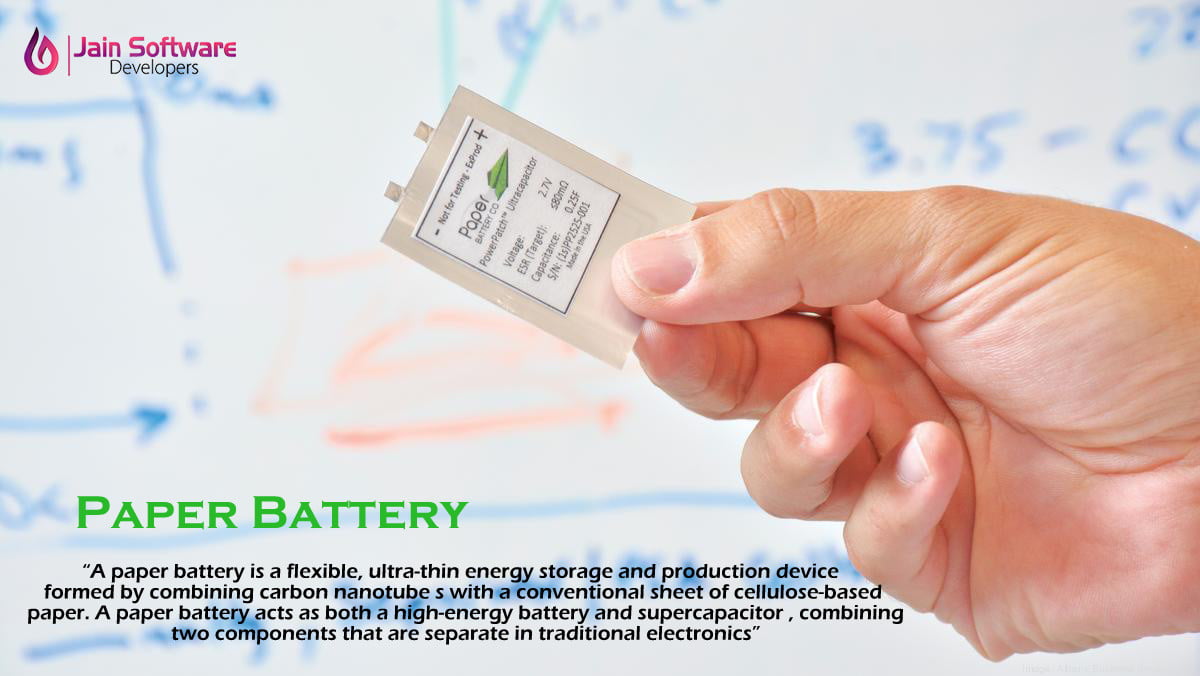
A paper battery is a flexible, ultra-thin energy storage and production device formed by combining carbon nanotube s with a conventional sheet of cellulose-based paper. A paper battery acts as both a high-energy battery and supercapacitor, combining two components that are separate in traditional electronics. This combination allows the battery to provide both long-term, steady power production and bursts of energy.In addition to being unusually thin, paper batteries are flexible and environmentally-friendly, allowing integration into a wide range of products. Their functioning is similar to conventional chemical batteries with the important difference that they are non-corrosive and do not require extensive housing.

How does Paper Battery work?

The conventional rechargeable batteries which we use in our day-to-day life consist of various separating components which are used for producing electrons with the chemical reaction of a metal and electrolyte. If once the paper of the battery is dipped in ion-based liquid, then the battery starts working i.e.,electricity is generated?by the movement of electrons from cathode terminal to anode terminal. This is due to the chemical reaction between the electrodes of paper battery and liquid. Due to the quick flow of the ions within a few seconds (10sec) energy will be stored in the paper-electrode during the recharging. By stacking various paper-batteries up on each other, the output of the paper battery can be increased.As the paper batteries are connected each other very closely for increasing their output, there is a chance of occurring short between the?anode terminal and cathode terminal. If once the anode terminal contacts with cathode terminal, then there will be no flow of current in the external circuit. Thus, to avoid the short circuit between anode and cathode a barrier or separator is needed, which can be fulfilled by the paper separator.


“Technology is driving the innovation. Technology is driving the creativity”


What are Paper Battery Properties?

The properties of the paper battery can be recognized from the properties of cellulose such as :-

  • excellent porosity
  • biodegradability
  • non-toxic
  • recyclability
  • high-tensile strength
  • good absorption capacity
  • low-shear strength

also from the properties of carbon nanotubes such as low mass density, flexibility, high packing density, lightness, better electrical conductivity than silicon, thin (around 0.5 to 0.7mm), and low resistance.

Paper Battery Manufacturing:-

One method is to grow the nanotubes on a silicon substrate and then filling the gaps in the matrix with cellulose. When the matrix is dried, the material can be removed the substrate. Combining the sheets together with the cellulose sides facing inwards, the battery structure is formed. The electrolyte is added to the structure.


“Technology will not replace great teachers but technology in the hands of great teachers can be transformational”


Applications of Paper Batteries:

With the developing technologies and reduction in the cost of cathode nanotubes, these batteries find applications in the following fields:

  • Nanotubes used for Paper Battery

Paper Battery= Paper (Cellulose) + Carbon Nanotubes

The paper battery can be used for various applications as it facilitates advantages such as folding, twisting, molding, crumpling, shaping, and cutting without affecting on its efficiency. As the paper batteries are the combination of cellulose paper and carbon nanotubes, which facilitates advantages of long-term usage, steady power, and bursts of energy. These types of paper batteries are estimated to use for powering the next generation vehicles and medical devices.

  • Paper batteries in electronics

Paper batteries are used mainly in many electronic devices, such as mobile phones, laptop batteries, calculators, digital cameras and also in wireless communication devices like mouse, Bluetooth, keyboard, speakers, and headsets.

  • Paper batteries in medical sciences

Paper batteries are used in the medical field such as for making pacemakers for the heart, artificial tissues, drug delivery systems, cosmetics and in Biosensors.

  • Paper batteries in automobiles and aircraft

Paper batteries are used in automobiles and aircraft such as in lightweight, guided missiles, hybrid car batteries, long air flights and in satellite programs for powering electronic devices.

This is all about the paper battery with its working principles and applications.

These batteries have the potential adaptability to power the next generation electronic appliances, medical devices and hybrid vehicles. So, these batteries could solve all the problems associated with conventional electrical energy storage devices. Furthermore, for any queries, regarding this article or any other?electrical projects, you can leave your comments, suggestions by commenting in the comment section below.

  • Electrochemical Batteries

Electrochemical batteries can be modified to integrate the use of paper. An electrochemical battery typically uses two metals, separated into two chambers and connected by a bridge or a membrane which permits the exchange of electrons between the two metals, thereby producing energy. Paper can be integrated into electrochemical batteries by depositing the electrode onto the paper and by using paper to contain the fluid used to activate the battery. The paper that has been patterned can also be used in electrochemical batteries. This is done to make the battery more compatible with paper electronics. These batteries tend to produce low voltage and operate for short periods of time, but they can be connected in series to increase their output and capacity. Paper batteries of this type can be activated with bodily fluids which makes them very useful in the healthcare field such as single-use medical devices or tests for specific diseases. A battery of this type has been developed with a longer life to power?point of care?devices for the healthcare industry. The device used a paper battery made using a magnesium foil anode and a silver cathode has been used to detect diseases in patients such as kidney cancer, liver cancer, and osteoblastic bone cancer. The paper was patterned using wax printing and is able to be easily disposed of. Furthermore, this battery was developed at a low cost and has other practical application.

  • Lithium-ion Batteries

Paper can be used in lithium-ion batteries as regular, commercial paper, or paper enhanced with single-walled carbon nanotubes. The enhanced paper is used as the electrode and as the separator which results in a sturdy, flexible battery that has great performance capabilities such as good?cycling, great efficiency, and good reversibility. Using paper as a separator is more effective than using plastic. The process of enhancing the paper, however, can be complicated and costly, depending on the materials used. A carbon nanotube and silver nanowire film can be used to coat regular paper to create a simpler and less expensive separator and battery support. The conductive paper can also be used to replace traditionally used metallic chemicals. The resulting battery performs well while simplifying the manufacturing process and reducing the cost. Lithium-ion paper batteries are flexible, durable, rechargeable, and produce significantly more power than electrochemical batteries. In spite of these advantages, there are still some drawbacks. In order for the paper to be integrated with the Li-ion battery, complex layering and insulating techniques are required for the battery to function as desired. One reason these complex techniques are used is to strengthen the paper used so that it does not tear as easily. This contributes to the overall strength and flexibility of the battery. These techniques require time, training, and costly materials. Additionally, the individual materials required are not environmentally friendly and require specific disposal procedures. Paper lithium-ion batteries would be best suited for applications requiring a substantial amount of energy over an extended period of time. Lithium-ion paper batteries can be composed of carbon nanotubes and a cellulose-based membrane and produce good results but at a high price tag. Other researchers have been successful using carbon paper manufactured from pyrolyzed filter paper. The paper is inserted in between the electrode and cathode.The use of a carbon paper as an interlayer in Li-S batteries improves the batteries efficiency and capacity. The carbon paper increases the contact area between the cathode and the electrode which allows for greater flow of electrons. The pores in the paper allow the electrons to travel easily while preventing the anode and the cathode from being in contact with one another. This translates into the greater output, battery capacity and cycle stability; these are improvements to conventional Li-S batteries. The carbon paper is made from?pyrolyzed?filter paper which is inexpensive to make and performs like multi-walled carbon nanotube paper used as a battery.

  • Biofuel Cells

Biofuel cells operate similarly to electrochemical batteries, except that they utilize components such as sugar, ethanol, pyruvate, and lactate, instead of metals to facilitate redox reactions to produce electrical energy. The enhanced paper is used to contain and separate the positive and negative components of the biofuel cell. This paper biofuel cell started up much more quickly than a conventional biofuel cell since the porous paper was able to absorb the positive biofuel and promote the attachment of bacteria to the positive biofuel. This battery capable of producing a significant amount of power after being activated by a wide range of liquids and then be disposed of. Some development must take place since some components are toxic and expensive.

Naturally occurring electrolytes might allow?biocompatible?batteries for use on or within living bodies. ?Paper batteries described by a researcher as a way to power a small device such as a pacemaker without introducing any harsh chemicals such as the kind that is typically found in batteries in the body.

Their ability to use electrolytes in the blood makes them potentially useful for medical devices such as?pacemakers,?medical diagnostic?equipment, and drug delivery?transdermal patches. German healthcare company KSW Microtech is using the material to power?blood?supply temperature monitoring.

  • Supercapacitors

Paper battery technology can be used in?supercapacitors. Supercapacitors operate and are manufactured similarly to electrochemical batteries, but are generally capable of greater performance and are able to be recharged. Paper or enhanced paper can be used to develop thin, flexible supercapacitors that are lightweight less expensive. The paper that has been enhanced with carbon nanotubes is generally preferred over regular paper because it has increased strength and allows for easier transfer of electrons between the two metals. The electrolyte and the electrode are embedded into the paper which produces a flexible paper supercapacitor that can compete with some commercial supercapacitors produced today. A paper supercapacitor would be well suited for a high power application.

  • Nanogenerators

Nanogenerators are a more recent device that converts mechanical energy to electrical energy. Paper is desirable as a component of nanogenerators for the same reasons discussed above. Such devices are able to capture movement, such as body movement, and convert that energy into electrical energy that could power LED lights, for example.


“When you take technology and mix it with art, you always come up with something innovative”


Advantages of Paper Battery:-?

The composition of these batteries is what sets them apart from traditional batteries.

  • Paper is abundant and self-sustaining, which makes paper cheap. Disposing of paper is also inexpensive since paper is combustible as well as biodegradable.
  • Using paper gives the battery a great degree of flexibility.
  • The battery can be bent or wrapped around objects instead of requiring a fixed casing.
  • Being a thin, flat sheet, the paper battery can easily fit into tight places, reducing the size and weight of the device it powers.
  • The use of paper increases the electron flow which is well suited for high-performance applications. Paper allows for capillary action so fluids in batteries, such as electrolytes, can be moved without the use of an external pump.
  • Using paper in batteries increases the surface area that can be used integrate reagents. The paper used in paper batteries can be supplemented to improve its performance characteristics.
  • Patterning techniques such as photolithography, wax printing, and laser micromachining are used to create hydrophobic and hydrophilic sections on the paper to create a pathway to direct the capillary action of the fluids used in batteries.
  • Similar techniques can be used to create electrical pathways on paper to create paper electrical devices and can integrate paper energy storage.

Disadvantages

Although the advantages of paper batteries are quite impressive, many of the components that make them great, such as carbon nanotubes and pattering, are complicated and expensive.


“The science of today is the Technology of future”


WEB SEARCH ENGINES

How Web Search Engines Work

By Author – Prankul Sinha


Introduction

A web search engine is a specialized software designed to search for information across the World Wide Web. It retrieves data from millions of web pages and presents the results to users in the form of Search Engine Results Pages (SERPs). These results can include web pages, images, videos, documents, and more.

Websites that have strong Search Engine Optimization (SEO) tend to appear on the first page of search results, which makes SEO a crucial factor for any website aiming for online visibility.

Before understanding how a search engine functions, it’s important to explore some key technical concepts:

  • Web Crawler

  • Robots.txt

  • Meta Tags


Web Crawler

A Web Crawler, also known as a spider, is an automated bot that systematically browses the internet to collect and organize information.

Search engines use crawlers to discover and analyze websites, updating their databases with new or modified content. Crawlers copy the pages they visit and send the data to search engines, where it is indexed. This process helps users quickly find relevant information during their searches.

In essence, web crawlers are the backbone of every search engine, ensuring that the web remains searchable and organized.


Robots.txt

The robots.txt file is part of the Robots Exclusion Protocol (REP), a standard that allows websites to communicate with web crawlers. It tells search engines which parts of a website should or shouldn’t be accessed or indexed.

For example, website administrators can use robots.txt to prevent crawlers from indexing confidential pages, duplicate content, or under-development sections.

However, not all crawlers respect these restrictions. Some malicious bots, such as email harvesters or malware scanners, may ignore the protocol entirely.

In addition, robots.txt can be used alongside sitemaps, which list all the pages of a website that should be indexed, helping search engines navigate more efficiently.


Meta Tags

Meta Tags are snippets of code placed in the head section of an HTML document. They provide structured information about a webpage, such as its description, keywords, author, and other metadata.

Search engines use this data to understand the content of the page and determine how it should appear in search results.

There can be multiple meta tags on a single page, and while some directly influence SEO, others serve informational purposes like specifying the page language or viewport settings.


Approach: How a Search Engine Works

A search engine’s functionality can be broken down into three main processes that operate continuously:

  1. Web Crawling

  2. Indexing

  3. Searching


1. Web Crawling

Search engines deploy web crawlers (spiders) that navigate the internet from one website to another through hyperlinks. Before crawling a website, the crawler checks the robots.txt file to see which pages it can or cannot access.

Crawlers analyze factors such as:

  • Page titles and content

  • HTML tags and metadata

  • JavaScript and CSS structures

  • Internal and external links

It’s impossible for a crawler to visit every page on the internet due to the sheer size of the web, infinite loops, and spam traps. Therefore, search engines use a crawl policy to determine the depth and frequency of crawling each website. High-quality and frequently updated websites are crawled more often.


2. Indexing

Once a page is crawled, the search engine indexes it. Indexing involves processing and storing relevant words, tags, and links from web pages into a massive database.

When a user performs a search query, the engine looks through this index rather than the live web, allowing it to deliver results in fractions of a second.

The indexing process associates words and phrases with their corresponding web pages, helping the engine match user queries with the most relevant results.

Search engines also create cached versions of pages — stored snapshots that can be served to users even if the original site is temporarily unavailable. This cached content preserves the version that was indexed, though it may differ from the current live page.


3. Searching

When a user enters a query into a search engine, the system scans its index to find the most relevant results. It uses ranking algorithms based on hundreds of factors, including:

  • Relevance of content

  • Page authority and backlinks

  • Loading speed and mobile-friendliness

  • User engagement metrics

The engine then displays results in an ordered list on the SERP (Search Engine Results Page). Websites that adhere to good SEO practices and provide valuable content are more likely to appear at the top.


Conclusion

Search engines are complex systems that combine advanced algorithms, web crawling, and indexing to deliver instant results to users. Understanding their functioning helps businesses and developers optimize their websites for better visibility and user engagement.

In today’s digital world, effective SEO and a proper understanding of how search engines work can make the difference between being found or forgotten online.

Why Should We Go For A Website?

The Importance and Purpose of Websites in the Modern World

By Author – Prankul Sinha

In today’s digital era, having a website is one of the easiest and most effective ways for any business to showcase and advertise its products. A well-designed website not only displays products beautifully but also helps a company build a strong relationship with its customers. It serves as a powerful online presence where customers can easily learn more about your offerings and even make purchases directly.

When a business has its own website, it experiences significant growth. A good website design attracts more visitors, which often leads to an increase in sales. Moreover, it allows business owners to track company performance conveniently from their phones or laptops — anytime, anywhere.

Websites are also useful for hiring. If a company is looking to recruit new employees, it can simply post job openings on its website, making it easy for potential candidates to apply online.

Websites in Education

In today’s world, schools and colleges are also relying heavily on websites. They use them not only to promote their institutions but also to manage many daily activities. Students can pay their fees through online portals, check announcements about events, and stay updated on all school or college activities.

Thus, the purpose of a website varies depending on the need — from business promotion to e-commerce, education, and entertainment. Below are a few examples:


1. The Purpose of E-Commerce Websites

The primary goal of e-commerce websites is to sell products online. Successful e-commerce sites are optimized to increase conversions — ensuring visitors make purchases with ease.

To achieve this, such websites use modern design and marketing strategies, smooth navigation, fast checkout systems, and multiple secure payment options. Reducing friction during the shopping process helps build customer trust and boosts sales.


2. The Purpose of Service-Based Business Websites

Service-based business websites aim to convince visitors to become customers. They build credibility by presenting the company as professional, experienced, and reliable.

Before reaching out, customers often review websites to evaluate a company’s expertise, reputation, and service quality. Including client testimonials, visual portfolios, and informative articles helps build trust and demonstrate authority in the field.

A well-structured service-based website ensures potential clients feel confident about choosing that company over others.


3. The Purpose of Social Media Websites

The main purpose of social media websites is to connect people — friends, families, and communities — allowing them to share photos, videos, and experiences.

However, social networks are not limited to personal use. Businesses use social platforms to build direct relationships with their customers, receive valuable feedback, and understand what their audience truly needs and expects.


4. The Purpose of Entertainment Websites

Entertainment websites are designed to engage and amuse visitors. These may include online magazines, celebrity news portals, sports updates, movies, humor, and more.

To keep users returning, these sites are updated frequently and offer interactive content such as videos, podcasts, and slideshows. An engaging entertainment website provides a fun and refreshing online experience for its audience.


Conclusion

In short, websites play an essential role in every field — from business and education to entertainment and social connection. They have become the digital face of modern organizations, helping them grow, communicate, and connect with the world more effectively.

Having a well-designed and functional website is no longer a luxury — it’s a necessity for anyone who wants to succeed in today’s fast-paced digital world.

SOCIAL MEDIA MARKETING

Social Media Marketing: The Power of Digital Connection

By Author – Prankul Sinha

Introduction

Social media marketing is one of the most powerful tools in the modern business world. It uses social media platforms and websites to promote products and services while helping brands connect directly with their audience.

Most social media platforms now include built-in data analytics tools that allow companies to measure the performance of their marketing campaigns in real time. According to reports, in 2014 more than 80% of business executives identified social media as an essential part of their business strategy. Retail businesses have also seen up to a 133% increase in revenue through social media marketing efforts.


Platforms Used in Social Media Marketing

1. Social Networking Websites

Social networking websites allow individuals, businesses, and organizations to interact, communicate, and build online communities. By joining these platforms, companies can promote and sell their products more efficiently while maintaining direct communication with their customers.

Consumers can express their needs, preferences, and values openly through these sites. This two-way interaction fosters a sense of trust and loyalty between businesses and their followers. When companies respond personally to users’ questions or feedback, they create stronger emotional connections, which often translate into long-term customer relationships.


2. Mobile Phones and Social Media

In today’s digital landscape, nearly half of the world’s population is online — and about 75% of them actively use social media through their mobile devices. This widespread mobile usage offers tremendous opportunities for businesses to reach millions of potential customers instantly.

For example, in 2012, Nextage — a real-time mobile advertising platform — reported a 37% monthly revenue increase, while Adfonic, another mobile ad publishing network, saw 22 billion ad requests in the same year.

Mobile devices have completely changed how people consume media. They have impacted everything from TV ratings to advertising and e-commerce. Mobile video streaming, audio platforms, and mobile shopping continue to grow rapidly. In the United States alone, more than 100 million users are expected to access online video content through mobile devices.

As of 2013, global mobile internet usage was at 73.4%, and by 2017, it was projected that over 90% of internet users would access content primarily through their phones.


Purposes of Social Media Marketing

One of the main purposes of using social media for marketing is communication. It helps businesses connect with potential and existing customers, increase brand visibility, and reach audiences that may not have previously known about their products or services.

Social media platforms also allow companies to create buzz, gather insights, and target audiences with precision. It is the only form of marketing that can engage consumers at every stage of their decision-making journey — from awareness to purchase.

Another key benefit of social media marketing is its strong impact on search engine optimization (SEO). Studies show that 7 out of the top 10 factors influencing Google’s organic search rankings are linked to social media activity. Simply put, brands that are inactive on social media are less likely to appear in search results.

While platforms like Facebook, Twitter (X), and Google+ once dominated with large user bases, visual platforms such as Instagram and TikTok have now shown higher engagement rates. For example, Instagram maintains an impressive 1.46% interaction rate among its 130 million monthly users, compared to Twitter’s 0.03% rate with 210 million monthly users.


Blogs and Content Marketing

Professional networking platforms like LinkedIn have created spaces where companies and clients can connect more meaningfully.

Forward-thinking businesses use blogs as a tool to share original content, promote products, and establish a unique voice in the digital space. Blogs help reach audiences who rely on social media for credible information.

Research from 2009 indicated that consumers find media coverage or blog mentions more trustworthy than traditional print advertisements because they are perceived as independent and unbiased.

Through blogs, companies can publish detailed product descriptions, customer testimonials, tutorials, and case studies. Blogs can be updated frequently and linked to other platforms like social media pages or newsletters, helping to build a consistent online presence.

Furthermore, online communities and discussion forums enable businesses to reach wider audiences — even the customers of other companies using the same platform. Employee review sites also help organizations evaluate their standing in the corporate world by gathering feedback directly from their teams.

However, not every company integrates social media into its traditional marketing strategy. Those that do must follow specific corporate standards when interacting online. To maintain a competitive advantage, businesses need to understand the four key assets that consumers value most:

  1. Information – Transparency and honesty in communication

  2. Involvement – Allowing customers to engage and participate

  3. Community – Building a shared sense of belonging

  4. Control – Giving customers a voice in shaping their experience


Conclusion

Social media marketing has transformed how businesses communicate and connect with the world. It offers real-time engagement, measurable results, and the ability to build genuine relationships with customers.

By understanding the power of various platforms — from social networks and mobile apps to blogs and online communities — companies can craft a strong, dynamic digital presence that not only attracts attention but also earns trust and loyalty in the long run.

Search Engine Optimization

By Author – Prankul Sinha


Introduction

Search Engine Optimization, commonly known as SEO, is the process of increasing traffic to a website through organic or natural search results on search engines. Popular search engines like Google, Yahoo, and Bing display search results in a ranked order — and the higher your page ranks, the more visibility your site receives.

A well-optimized website has better chances of appearing among the top 10 search results. SEO involves improving the website’s content, HTML structure, and coding to make it more relevant to specific keywords while ensuring that there are no barriers to search engine indexing.

Another major part of SEO is link building, which involves increasing the number of backlinks (inbound links from other websites). These backlinks act as endorsements for your website, signaling to search engines that your content is credible and worth ranking higher.


Types of SEO

SEO can be broadly divided into two main categories:

  1. On-Page SEO

  2. Off-Page SEO


On-Page SEO

On-Page SEO refers to all the techniques and settings that can be implemented directly on your website to improve its search engine ranking.

This includes optimizing content with keywords, using meta tags and meta descriptions, improving internal linking, creating a customized URL structure, adding alt text to images, and ensuring high-quality, valuable content for users.


Types of On-Page SEO

1. Backlinking

Backlinking plays a major role in establishing authority and credibility. When you link to reliable and high-ranking websites, search engines like Google consider your website more trustworthy.

Creating multiple backlinks to authoritative sites can also increase the likelihood of earning reciprocal backlinks, meaning those sites might link back to you in the future. This exchange of links significantly improves your website’s traffic and search visibility.


2. Meta Description

A meta description is the short piece of text that appears below your website’s title on search engine result pages (SERPs).

This description helps users understand what your page is about and determines whether they click on your link or move on to another result. A strong, clear, and keyword-rich meta description can greatly improve your click-through rate (CTR) and overall search ranking.


3. Image SEO

Images are an essential part of a website, but they also need to be optimized for SEO. Image SEO ensures that your images appear in Google Image Search results, bringing in additional traffic to your website.

When a user clicks on an optimized image, they are redirected to your site — generating potential leads. To achieve this, make sure to:

  • Use descriptive filenames

  • Add relevant alt attributes

  • Compress images for faster loading times

Well-optimized images improve both user experience and search engine ranking.


Off-Page SEO

Off-Page SEO involves activities performed outside your website to enhance its authority, popularity, and trustworthiness. These actions signal to search engines that your website is valuable and credible.

Here are some key off-page SEO techniques:


1. Sharing Content

Creating valuable content is only half the job — sharing it is equally important. Posting your blogs or updates on social media platforms, forums, and other online communities can significantly increase visibility.

Your friends, followers, or professional connections may further share your post, expanding your reach exponentially. If your content is relevant and interesting, it has the potential to go viral and drive huge traffic to your website.


2. Likes and Star Ratings

The number of likes, shares, and ratings your content receives also impacts your SEO.

When a post gains positive ratings or reviews, it signals credibility and trustworthiness to both your audience and search engines like Google. In particular, star ratings act as a form of online review — improving user perception and ranking power.


3. Answering Queries and Being Responsive

Engagement is the heart of off-page SEO. When your audience leaves comments or questions, it shows they are genuinely interested in your content.

By responding promptly and helping users, you build trust and deepen engagement. This responsiveness not only improves customer relationships but also enhances your brand image and online reputation.


4. Understanding User Intent

Knowing what your audience is looking for is essential for successful SEO. Spend time researching trending topics, user preferences, and market demand before publishing new content.

By addressing your target audience’s interests and needs, you can generate more engagement, improve dwell time, and establish your website as a reliable information source. Staying updated with the latest industry trends also gives you a competitive advantage.


5. Building a Personal Connection

Off-Page SEO is not just about technical tactics — it’s also about building relationships.

Engage with your readers on social media, reply to their comments, and maintain a friendly tone. The more you interact personally, the more familiar and connected your audience will feel with your brand. This emotional connection can transform one-time visitors into loyal followers and customers.


Conclusion

Search Engine Optimization is much more than just ranking higher on Google — it’s about creating value, trust, and meaningful engagement.

By mastering both On-Page and Off-Page SEO techniques, businesses can dramatically increase their visibility, traffic, and credibility online. Whether it’s optimizing your meta tags, improving backlinks, or connecting personally with your audience, SEO remains one of the most powerful tools for sustainable digital growth.

Smart Note Taker

Smart Note Taker :-

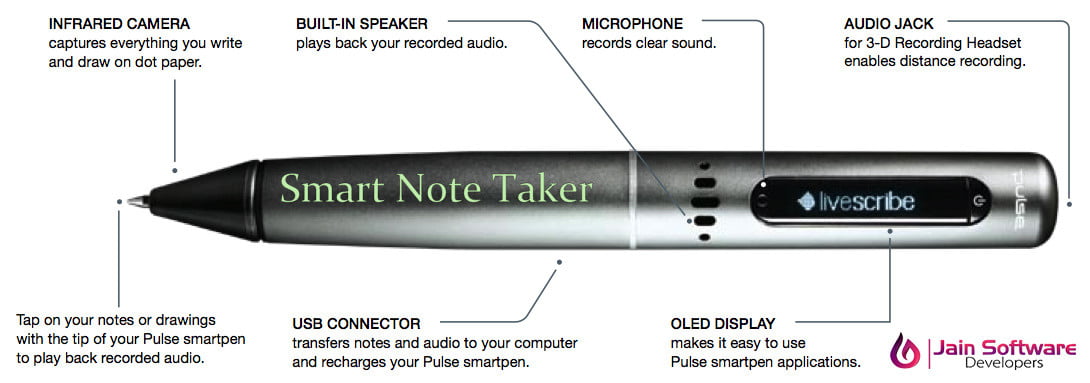
The Smart Note Taker is such a helpful product that satisfies the needs of the people in today’s technological and fast life. This product can be used in many ways. The Smart NoteTaker provides taking fast and easy notes to people who are busy with something else. With the help of Smart NoteTaker, people will be able to write notes on the air, while being busy with their work

The written note will be stored on the memory chip of the pen and will be able to read in digital medium after the job has done. This will save time and ease life. The smart note taker is good and helpful for blinds that think and write freely. Another place, where this product can play an important role, is where two people talks on the phone. The subscribers are apart from each other while their talk and they may want to use figures or texts to understand themselves better. It’s also useful especially for instructions in presentations.

The instructors may not want to present the lecture in front of the board. The drawn figure can be processed and directly sent to the server computer in the room. The server computer then can broadcast the drawn shape through network to all of the computers which are present in the room. By this way, the lectures are aimed to be more efficient and fun. This product will be simple but powerful. The product will be able to sense 3D shapes and motions that user tries to draw. The sensed information will be processed and transferred to the memory chip and then will be monitored on the display device. The drawn shape then can be broadcasted to the network or sent to a mobile device.

“Technology is the best when it brings people together”

Technical Definition of Smart Note Taker:-

In order to meet the technical requirements of the product we need Operating System Like Windows or Linux in order to implement software part of the project, Displacement Sensors to recognize the displacement of the pen in three dimensions, parallel cable to communicate with computer, software to solve the displacement data and finds the individual coordinate displacements in three axes and transform the data into text format, analog to digital converter to process analog displacement data and convert them into digital format, switch to control the pen and Rechargeable battery.

  • Analog to digital converter
  • Software program to convert data into text or string format
  • Operating System ??Parallel cable
  • Switch
  • Rechargeable battery
  • Displacement Sensor

“It’s Not faith in technology, It’s Faith in People

Note Taker for PC:-

PC Notes Taker is the world’s first device that captures natural handwriting on any surface onto a PC in real time. Based on a revolutionary electronic pen, PC Notes Taker displays the user’s handwritten notes, memos or drawings on the computer, and stores the image for future use. PC Notes Taker is ideal for markets where the handwritten input is essential, such as health, educational and financial sectors. Supplied with user-friendly software, PC Notes Taker is compatible with PCs and notebooks.

Adds Handwriting Input to any Computer PC Notes Taker is the world’s first device that captures natural handwriting on any surface onto a PC in real time. Based on a revolutionary electronic pen, PC Notes Taker displays the user’s handwritten notes, memos or drawings on the computer, and stores the image for future use. PC Notes Taker is ideal for markets where the handwritten input is essential, such as health, educational and financial sectors. Supplied with user-friendly software, PC Notes Taker is compatible with PCs and notebooks.

Features:-

Capture of handwriting from any plain paper or other writing surface Input of continuous writing up to A4 page size Insert sketches, signatures, equations, and notes into Word documents E-mail sketches or handwritten notes in any language using MS OUTLOOK Convert handwriting to digital text using MS word recognition engine Annotate, add comments, edit and draw in your own handwriting onto MS office documents Create instant messaging using ICQ

The Smart Pen system includes the Smart Pen and a pen cradle connected to an internet-enabled computer. As CRFs are filled out, the Smart Pen records each stroke. It identifies each CRF and where it is on the page through a very fine grid pattern that appears as a light gray background shading on the CRF. The Pen is then placed in the cradle, activating a password-protected Internet link to Health Decisions. Data are interpreted into fields and validation can occur immediately, with queries returned to sites quickly over the Internet. The process also creates an exact copy of the original CRF that can be read for notation and comparison with interpreted data fields. Health Decisions takes the best technology and applies it to your clinical trials.

“In Technology Whatever can be done will be done”

Note Taker for mobile:-

The Ultimate Handwriting Capture Device Mobile NoteTakerTM is the worlds first portable handwriting capture device based on natural handwriting as an input. Attach plain paper of any kind and use the Pegasus electronic pen to capture, store and share handwritten drawings, sketches, notes, and memos at meetings, lectures, and conferences.

Mobile NoteTakerTM has a built-in LCD to confirm input. The on-board flash memory can store up to 50 pages.

Features:-

Uses standard paper – no special paper required Stores up to 50 A4 pages Includes LCD to view and confirm input Operates both in mobile mode and when connected to PC, notebook or other device Connects to PC/Notebook via USB cable (included) Includes software for synchronization and management of stored files Writes directly into MS Office applications (in Connected mode) Allows file transfer over LAN, email, and instant messaging application (in connected mode).

Capture, Organize, and Share Your Notes Digitally-Anywhere, Anytime!
Mobile Mode Enables capture and storage of notes and sketches digitally at meetings, lectures, and conferences.

“Because People who are crazy enough to think they can change the world are the ones who do”

Connected Mode

Synchronizes the Mobile NoteTakerTM and a PC/Notebook via USB cable (included). You can upload, organize, move, edit or add to handwritten notes, ideas, sketches, phone numbers, or reminders. The included software also enables memos, notes, and sketches to be sent via e-mail or over the LAN network. It is also possible to write directly into MS Word or Outlook, and add a personal touch to ICQ instant messages. Based on Pegasus successful PC Notes Taker, Mobile NoteTakerTM is the ultimate handwriting capture device. Everything you need to get started is right in the box. Even if you dont have standard size paper or piece of paper with you-you can use anything – an envelope, an old receipt, a tear-off from a paper bag and best of all in your own natural and writing.

As long as you have the Mobile NoteTakerTM, you can jot down your most inspired ideas and be sure that you will never lose them again.

Pill Camera

What is wireless capsule enteroscopy (Pill Camera)?

Wireless capsule enteroscopy also known as pill cam is a relatively new method of diagnosing diseases within the?small intestine.

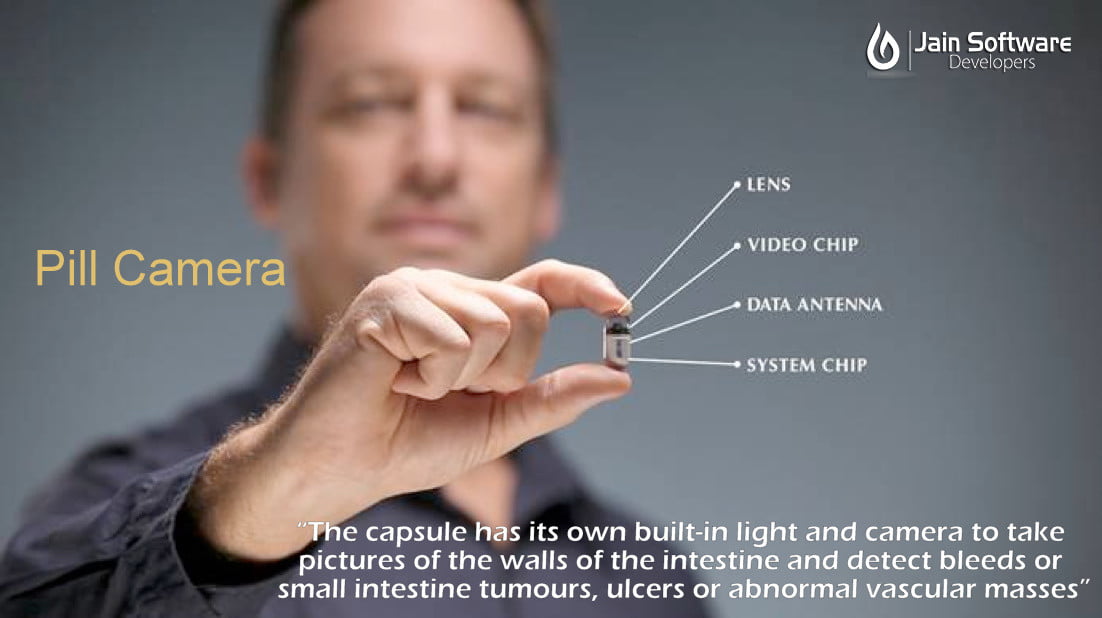
For detecting diagnosis a pill-sized video capsule is swallowed, which slowly travels through your intestine before being naturally excreted. The capsule has its own built-in light and camera to take pictures of the walls of the intestine and detect bleeds or small intestine tumors, ulcers or abnormal vascular masses. 2-4 images are taken per second for up to 8 hours. The images are transmitted to a recorder that is worn around the waist.

You may require this investigation if you have abnormal bleeding or are suspected to have Crohn’s disease. This investigation is non-invasive and allows doctors to examine all three portions of the small intestine

  • Duodenum,
  • Jejunum and
  • Ileum

which often cannot be reached by other imaging methods.
What is Capsule Endoscopy used for?

Capsule enteroscopy allows your doctor to visualize the small intestine which is often missed by conventional imaging methods such as upper gastrointestinal endoscopy or colonoscopy. The most common reason for ordering this investigation is to look for sources of bleeding. You may have noticed blood in yo ur vomit or faeces, or have unnoticed blood loss that can cause iron deficiency anaemia. This investigation can identify polyps, inflammatory intestine disease (Crohn’s disease or?ulcerative colitis), ulcers and tumors that may be the source of the bleeding. Such lesions may not have been found by previous investigations but once identified; your doctor can decide an appropriate course of management.

The other main use is for evaluating the extent of Crohn’s disease, which commonly affects the small intestine. This investigation is particularly useful for detecting early disease which may be missed by barium examination and CT. Also, it can be useful in patients who have symptoms which do not match the extent of disease (if any) seen by conventional imaging techniques.

Wireless capsule enteroscopy may have further indications in the future as it is safe, easy to perform, non-invasive and doesn’t require sedation. In particular, if techniques are invented that allow treatments or biopsies (tissue sampling) to be performed at the time of the procedure, it will become a very useful procedure.

It should be noted that this investigation may not always be the best for you. The images taken by the camera are of poorer quality than those obtained by upper gastrointestinal endoscopy or colonoscopy. In addition, the camera may move too fast or slow to examine or the appropriate areas or be facing the wrong way and miss some lesions. Thus, it is only one possibility?of a series of investigations you may require in order for your doctor to make a correct diagnosis.
How do you prepare for the procedure?

Prior to the procedure, your doctor will explain what the procedure involves, risks, benefits and why it is indicated in your case. You will need to fast (don’t eat or drink) for around 10 hours before the investigation, as it is safest and produces the best results when the intestine is empty.

No fluid is taken for at least 2 hours and no food for a further 4 hours after swallowing the capsule. Oral medications can be taken after 2 hours if required.

If you are diabetic, the medication must be stopped during the fasting period and insulin use should be discussed with your doctor.

There is usually no need for intestine preparation, but strong colored tablets (e.g. iron tablets) should be avoided for about 24hrs before the procedure.
What does the procedure involve?

For the procedure, you will be required to swallow a 26x11mm endoscopy capsule equipped with a video camera, light source, radio transmitter, and batteries. The capsule is swallowed with a substance called simethicone, to prevent bubbles forming and interfering with the images.

The capsule passes naturally through your body via peristalsis (contraction and propelled by the muscular walls of the gastrointestinal tract) while it takes many images. The images are detected by a sensor device attached to your abdomen with 8 small aerials taped to the skin (similar to the electrodes used for an ECG). These are recorded and stored on the image recorder worn around your waist.

After approximately 8 hours you will be required to return to the medical center so the images can be downloaded and examined on a computer monitor by the physician. Around 50,000 images will be taken per investigation, so it can take a long time for these to be examined and processed. Your doctor will normally inform you of the results within a week.

You should pass the capsule naturally after 8-72 hours, but it can sometimes take up to two weeks. If you haven’t passed the capsule by this time, an X-ray may need to be performed to see if it is still present or obstructed. The capsule is discarded after it has been excreted.
What are the risks?

Capsule enteroscopy is a safe procedure and is well tolerated by most patients. Less than 1 in 10 people have difficulty swallowing the capsule, which has a gel coating to help you swallow it.

The main risk is retention of the capsule, which occurs in about 1 in a hundred people. The capsule becomes impeded by a stricture (narrowing) secondary to a tumor, inflammation or scarring from previous surgery. It is not dangerous in the short term, but you may require a surgical intervention to remove it. Obstruction may present as bloating, vomiting or pain. You should consult your doctor promptly if you experience these symptoms. In most cases, the capsule will pass naturally from the body without any problems.


Generic Visual Perception Processor

Introduction

The Generic Visual Perception Processor (GVPP) is an advanced single-chip system inspired by the human brain’s visual perception capabilities. Designed to detect, locate, and track objects in real time from motion video signals, GVPP imitates the neural networks of the human eye and brain.

This electronic “eye” is capable of processing approximately 20 billion instructions per second (BIPS) — a remarkable achievement that allows it to handle complex visual tasks such as object detection, movement tracking, and environmental perception with exceptional accuracy.


How GVPP Works

The GVPP functions by analyzing a continuous stream of visual information — much like the human visual system. It processes incoming video signals, converts them into digital information, and extracts meaningful data such as object position, shape, and velocity.

By modeling both the temporal (time-based) and spatial (location-based) functions of the human eye-brain system, the GVPP views its surroundings as a dynamic series of histograms that represent object locations and movements.

It is equipped with advanced capabilities like:

  • Automatic adaptation to object size, orientation, and lighting changes.

  • Real-time object tracking, even under varying light conditions.

  • Learning-in-place capability — allowing it to improve performance without reprogramming.

This means GVPP can function seamlessly in daylight or darkness, adapting to real-world conditions much better than most traditional vision systems.


Applications of GVPP

Because of its ability to perceive and interpret visual data like humans, the GVPP can be used in a wide range of fields, such as:

  • Autonomous driving systems – recognizing and tracking vehicles, pedestrians, and obstacles.

  • Agriculture – selecting ripe fruits or identifying plant diseases.

  • Industrial automation – performing tasks that require visual precision.

  • Security and surveillance – detecting unusual movements or activities.

  • Robotics – enhancing the perception abilities of humanoid or industrial robots.

While GVPP imitates human visual processing, it is not designed as a medical device — meaning it cannot cure blindness or replace biological vision. However, its role in machine vision is revolutionary.


Overcoming the Limitations of Traditional Processors

For decades, computing technology has faced limitations due to the design of traditional processors. These processors work by breaking down complex tasks into smaller, simpler steps that follow a strict algorithmic structure.

However, many real-world problems do not have a clearly defined algorithm — making traditional processors inefficient or incapable of handling them.

This is where GVPP’s neural learning architecture makes a breakthrough. By mimicking how the human brain learns and adapts, GVPP can:

  • Process information without needing a fixed algorithm.

  • Learn and adapt from real-time data.

  • Handle unpredictable or undefined input patterns effectively.

This neural learning model makes GVPP highly fault-tolerant — even if some parts of its network fail, it continues functioning with minimal performance loss. Traditional processors, by contrast, often fail completely when even a few components are damaged.


The Power of Neural Networks in GVPP

GVPP’s foundation lies in neural network-based computing. Neural networks are capable of recognizing, storing, matching, and processing patterns — even those that might not be immediately understandable to human programmers.

For example:

  • If a GVPP receives input data containing hidden or complex patterns, it can still identify and process them efficiently.

  • It does not require pre-defined instructions to interpret such data.

This makes GVPP exceptionally powerful for pattern recognition, machine learning, and image analysis tasks, positioning it as a key enabler for future AI-driven technologies.


Key Advantages of GVPP

  1. Real-Time Object Detection and Tracking:
    The processor continuously detects and monitors object movement with high precision.

  2. Adaptive to Lighting Conditions:
    Unlike conventional systems that require constant recalibration, GVPP automatically adjusts to changes in illumination — whether it’s bright daylight or complete darkness.

  3. Neural Learning Capabilities:
    It can “learn” and adapt to new situations over time, improving accuracy and speed.

  4. Fault Tolerance:
    Even with partial system damage, GVPP maintains smooth performance instead of total failure.

  5. High-Speed Processing:
    With the ability to handle 20 billion instructions per second, it enables rapid decision-making and real-time analysis.


Conclusion

The Generic Visual Perception Processor (GVPP) represents a monumental leap toward creating machines that can see, understand, and adapt like humans.

By integrating principles of neural networks and biological perception, GVPP bridges the gap between traditional computing and true artificial intelligence. Its ability to function efficiently under changing environments, recognize patterns, and learn from data makes it a cornerstone for the next generation of autonomous systems, robotics, and smart devices.

In the journey toward developing intelligent vision for machines, the GVPP stands as a testament to how far technology has come — and how close we are to mimicking the human brain’s incredible capabilities.

What is Security Trend?

Emerging IT Security Trends: A Glimpse into the Future

By Author – Rashmita Soge

As technology continues to evolve, organizations are arming themselves with advanced IT security innovations to detect and prevent potential breaches before they occur. By collaborating, contributing, and sharing knowledge about current security trends, industries can identify the most pressing challenges and areas where further guidance is needed.

In essence, the direction of security trends often follows broader technological advancements. In recent years, technologies like Artificial Intelligence (AI), the Internet of Things (IoT), and Data Privacy have transformed the global digital landscape. Let’s explore some of the key technology and security trends that continue to shape businesses and governments in their quest for efficiency and enhanced connectivity.


1. Internet of Things (IoT)

The Internet of Things continues to expand, connecting more everyday objects to the digital ecosystem. However, as IoT devices grow in number, so do the associated security risks. Many IoT devices lack robust protection and cannot be easily patched or upgraded, leaving them exposed to cyberattacks.

When compromised, these devices can lead to severe consequences—ranging from service disruptions and privacy violations to infrastructure failures. To mitigate these risks, stronger protection measures and national regulations must be established to ensure that all IoT devices meet minimum security standards. While implementing such safeguards may increase costs and reduce convenience, they are essential for building a safer connected environment.


2. Artificial Intelligence (AI)

Artificial Intelligence is transforming how organizations detect and respond to cyber threats. Many technology providers are developing AI-powered systems that can identify and neutralize security risks in real-time, long before human intervention is needed. This growing reliance on AI presents major opportunities for developers to create more intuitive, predictive, and secure systems.

However, AI is a double-edged sword. Just as it enhances cybersecurity, it can also be exploited by hackers. Malicious actors can use AI to identify vulnerabilities and infiltrate systems with unprecedented speed and precision. As a result, managing AI-related risks will remain a critical challenge for years to come.


3. Cryptocurrency

The rise of digital currencies like Bitcoin has introduced new layers of complexity to cybersecurity. While cryptocurrencies gained massive popularity and market value in recent years, they also present challenges related to security, scalability, and legitimacy.

Existing cryptocurrency systems may be vulnerable to future threats such as quantum computing attacks. To safeguard digital assets, cryptocurrency networks must evolve with stronger security protocols, and investors must pay close attention to how their chosen platforms manage security. Without adequate protection, there’s a real risk of losing investments overnight.


4. Cloud Computing

The growing adoption of cloud services has revolutionized data management, but it has also exposed users to new forms of vulnerability. Several high-profile breaches in recent years have shown how crucial cloud security is for both businesses and individuals.

The convenience and affordability of cloud computing often outweigh the perceived risks for most users. However, industries that handle sensitive data—such as defense, finance, government, and law—must remain cautious. For them, maintaining control over their information may be more important than the convenience of cloud-based storage.


5. Data Privacy

Data privacy, also known as information privacy, defines the control individuals or organizations have over what data can be shared or accessed by third parties. In the digital age, this aspect of IT has become one of the most pressing concerns.

Every connected device collects and stores information about users—their preferences, habits, and locations—creating a massive digital footprint. This growing database of personal information raises serious ethical and security concerns. Protecting user privacy will remain a major challenge as technology continues to advance, demanding stricter data policies and greater awareness from users.


Conclusion

As technology continues to advance at a rapid pace, so do the risks and opportunities in cybersecurity. The trends in IoT, AI, cryptocurrency, cloud computing, and data privacy underscore the importance of proactive security measures. To thrive in this digital era, organizations must stay vigilant, invest in secure infrastructures, and continuously adapt to the evolving landscape of cyber threats.

Request a Free Estimate
Enter Your Information below and we will get back to you with an estimate within few hours
0